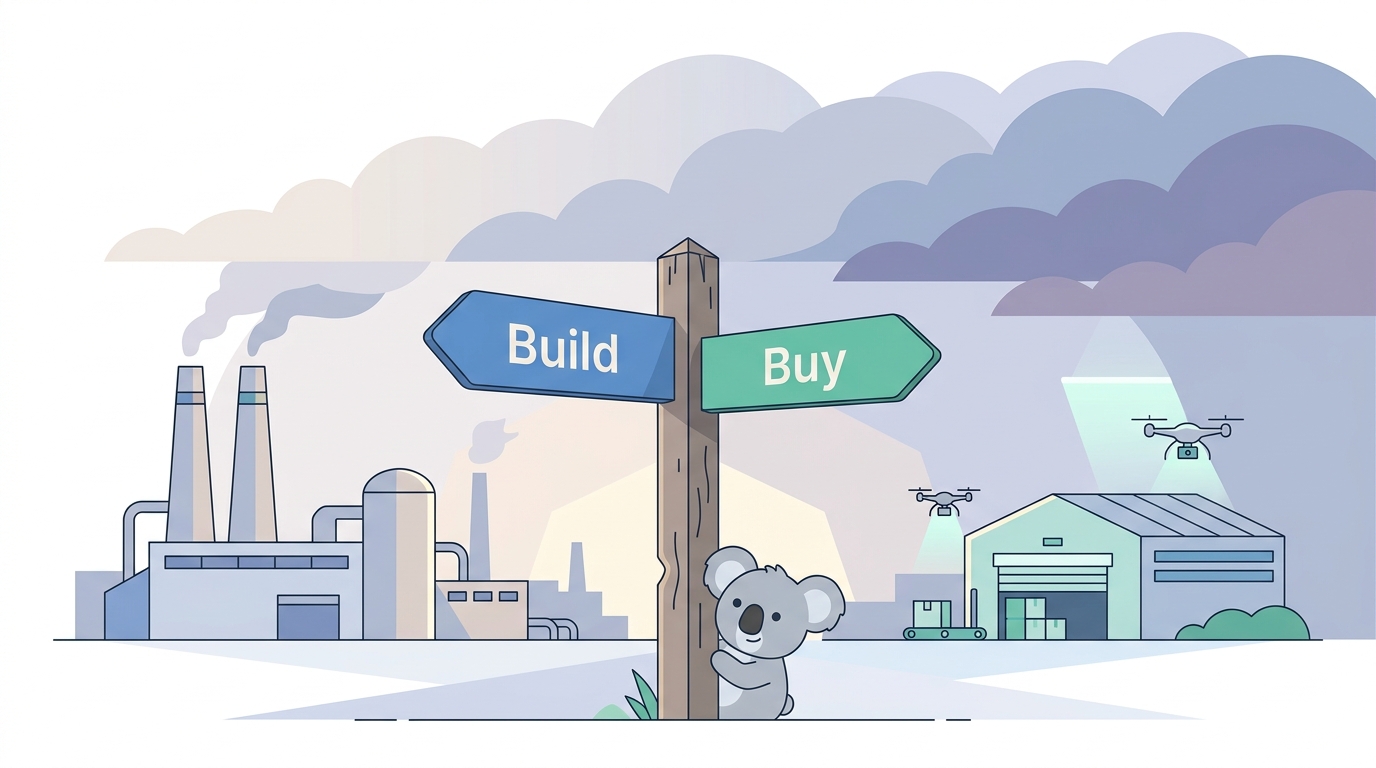
Build vs. Buy: Evaluating LLM Platforms for Enterprise Scale
The decision to build or buy your LLM infrastructure isn’t a technology choice—it’s a bet on where your competitive advantage lives. Get it wrong, and you’ll either hemorrhage engineering hours on commodity problems or find yourself locked into a platform that can’t evolve with your needs.
After working with multiple enterprises navigating this decision, I’ve seen both paths succeed and fail spectacularly. The difference rarely comes down to technical capability. It comes down to honest assessment of what your organisation actually needs versus what it thinks it wants.
The Real Cost Calculation Most Teams Skip
Every build vs. buy analysis I’ve reviewed focuses on the wrong comparison. Teams compare the monthly cost of an LLM platform against the salary of engineers who would build an equivalent system. This is like comparing the price of a car to the salary of someone who could theoretically build one.
The honest calculation requires accounting for:
Direct costs you’ll acknowledge: Platform subscription fees, API costs, compute infrastructure. These are easy to model and often favour building once you hit scale.
Hidden costs you’ll discover later: Security reviews, compliance documentation, on-call rotations, incident response, model evaluation pipelines, prompt versioning systems, A/B testing infrastructure. Platforms like Anthropic’s Claude, OpenAI, or Azure OpenAI Service bundle these. Building means owning them forever.
Opportunity costs you’ll underestimate: Every senior engineer debugging your RAG pipeline is an engineer not shipping your core product. At current market rates, that’s a quarter-million dollar annual decision per person.
The break-even point where building makes financial sense is higher than most teams estimate—typically around $500K-800K in annual platform spend, assuming you have an existing ML infrastructure team. Without that team, multiply by three.
When Building Actually Makes Sense
Despite the cost analysis, building remains the right choice in specific scenarios. The key is recognizing these scenarios honestly rather than retrofitting justification.

You need control over the model layer itself. If your competitive advantage requires fine-tuning on proprietary data, custom model architectures, or inference optimizations that platforms don’t expose, building is unavoidable. Financial trading firms, drug discovery companies, and defence contractors often fall here. Platforms like Amazon Bedrock or Google Vertex AI offer some fine-tuning capabilities, but deep customisation still requires infrastructure control.
Your regulatory environment demands it. Some industries face compliance requirements that preclude sending data to third-party APIs, even with enterprise agreements. Healthcare organizations handling PHI, government contractors, and financial services with specific data residency requirements may have no choice but to self-host using frameworks like vLLM or Hugging Face Text Generation Inference.
You’re operating at genuine hyperscale. When you’re processing billions of tokens daily, the economics shift. But “hyperscale” is often invoked prematurely. True hyperscale means inference costs dominate your cloud bill, not that you anticipate they might someday.
Your latency requirements are extreme. Real-time applications with sub-100ms latency budgets for LLM inference may need custom deployment topologies. This is rare—most “real-time” requirements can be met with streaming responses and thoughtful UX—but legitimate cases exist.
When Buying Wins (Hint: More Often Than You Think)
Most enterprise teams should buy, at least initially. The platforms have matured faster than the ecosystem’s mental models.
Time-to-value dominance. A platform like LangChain’s LangSmith or Weights & Biases can have you running production-grade LLM applications with observability, evaluation, and deployment infrastructure in days. Building equivalent infrastructure takes months, minimum.
The feature velocity problem. Model providers ship improvements weekly. Anthropic’s Claude gains capabilities, OpenAI releases new endpoints, Cohere optimizes embedding models. Platforms abstract this churn. Internal systems become technical debt the moment they’re deployed.
Security and compliance as a service. Enterprise platforms have already completed SOC 2, achieved HIPAA compliance, negotiated DPAs, and built the audit logging your security team will demand. This represents hundreds of hours of work you don’t have to do.
Operational maturity you can’t replicate quickly. When your self-hosted inference cluster fails at 2 AM, you’re paging your engineers. When a platform fails, you’re reading their status page while their SRE team handles it.
The Hybrid Path Nobody Talks About
The cleanest decisions are rarely pure build or pure buy. The most successful implementations I’ve seen follow a progressive ownership model.
Start with platform APIs. Use OpenAI, Anthropic, or Google’s Gemini directly. Validate your use case. Understand your actual traffic patterns, latency requirements, and cost sensitivity with real data.
Add an abstraction layer. Once you’re confident in the use case, introduce an internal API gateway. This can be as simple as a thin proxy service that normalizes requests across providers. Tools like LiteLLM can accelerate this. Now you can switch providers without changing application code.
Selectively build where it matters. With usage data in hand, identify the specific components where building provides genuine advantage. Maybe it’s a custom embedding model for your domain. Maybe it’s a specialized RAG pipeline. Build those components while keeping commodity infrastructure on platforms.
Never build observability yourself. This is the hill I’ll die on. LLM observability—tracing, evaluation, cost tracking, prompt management—is complex, rapidly evolving, and completely undifferentiated for your business. Use LangSmith, Helicone, Arize Phoenix, or similar platforms. The engineering hours required to build and maintain equivalent tooling will never pay back.
Making the Decision Stick
The worst outcome isn’t choosing wrong—it’s choosing tentatively. Teams that half-commit to building end up with systems that are too custom to abandon and too incomplete to rely on. Teams that half-commit to platforms end up with shadow infrastructure sprouting across the organisation.
Whatever you choose, commit for at least 12 months. Build the organisational muscle memory. Create internal expertise. Document your patterns. Then reassess with real operational data rather than projections.
The build vs. buy decision for LLM infrastructure will continue evolving as the technology matures. What’s clearly a “buy” decision today might shift as open-source models improve and operational tooling commoditizes. The advantage goes to teams that build decision-making frameworks rather than one-time decisions.
At Koalabs, we help engineering teams navigate these decisions by bringing operational experience across both paths. If you’re facing a build vs. buy decision and want a grounded assessment of your specific situation, we should talk.