
Choosing Boring Technology in 2026: A Decision Framework for Technical Founders
Dan McKinley’s “Choose Boring Technology” essay turned ten this year. Its core insight—that every technology choice depletes a finite innovation budget—remains true. But the landscape has shifted. The boring options of 2015 aren’t necessarily the boring options of 2026, and the calculus for technical founders has become simultaneously simpler and more treacherous.
Here’s a decision framework for making these calls when you’re building with limited runway and can’t afford to rewrite your stack in eighteen months.
The Innovation Token Economy Has Inflated
McKinley’s original framing gave you three “innovation tokens” to spend on new, exciting, poorly-understood technology. The rest of your stack should be boring: proven, well-documented, with failure modes you understand.
In 2026, this economy has shifted in two important ways.
First, yesterday’s exciting technology has graduated to boring. PostgreSQL with JSONB handles 90% of what sent teams scrambling to MongoDB in 2014. TypeScript is no longer a bet—it’s the default. Kubernetes, while complex, has predictable failure modes and a decade of battle scars documented in incident reports you can actually learn from.
Second, the penalty for choosing wrong has increased. Engineering talent is expensive. Your early hires need to ship features, not fight infrastructure. A wrong technology bet doesn’t just cost time—it costs the morale of the people you most need to retain.
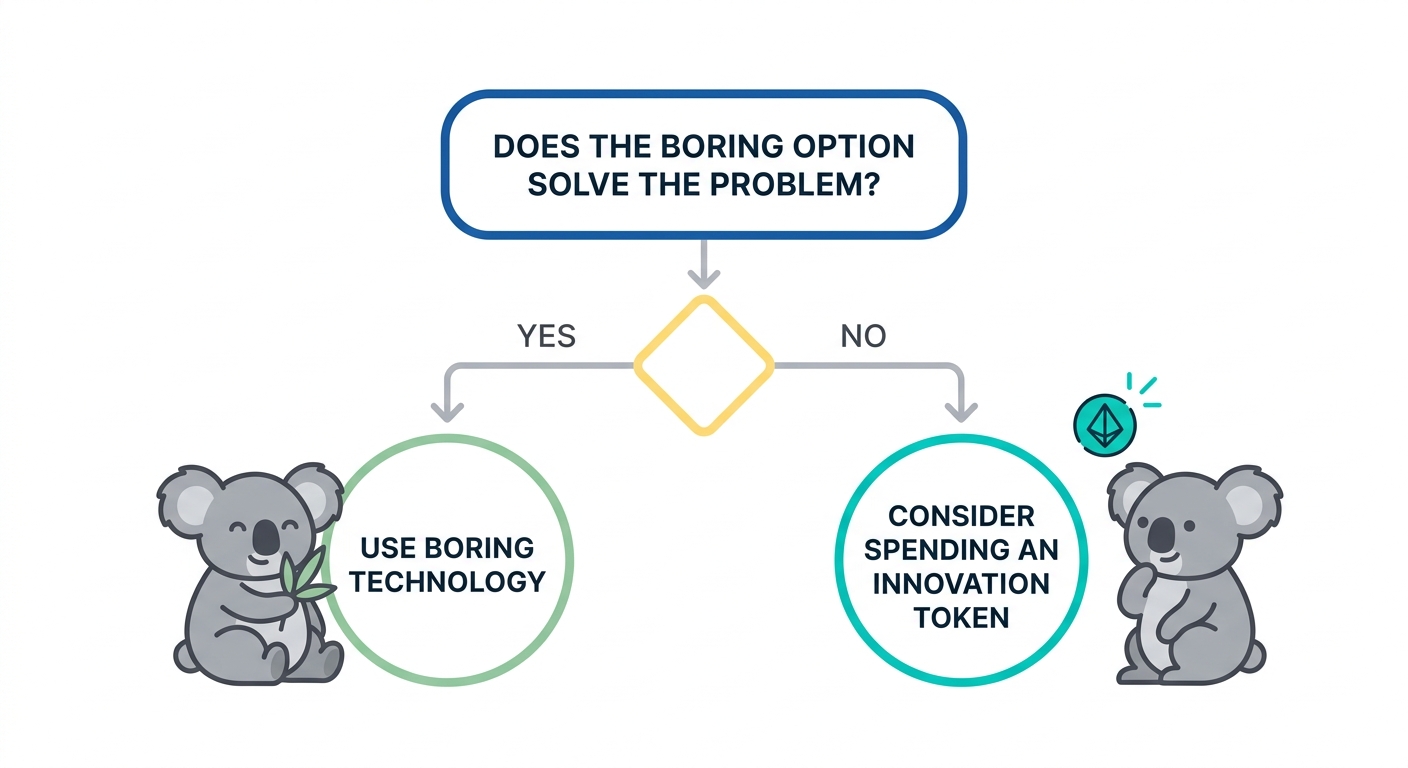
The practical implication: your innovation tokens should almost never be spent on infrastructure. Spend them on your product’s differentiating capabilities, not on reinventing deployment or data storage.
A Framework for the Decision
When evaluating any technology choice, run it through these four filters:
Operational maturity: Can you find a detailed incident report from a company at 10x your current scale? If the technology has been run in production long enough for people to write “what we learned when X broke” posts, you’re looking at something with known failure modes. Unknown failure modes are where startups die.
Hiring pool depth: Search your preferred job board. How many engineers list this technology? More importantly, how many good engineers list it as a secondary skill? Boring technology attracts people who want to solve business problems, not resume-pad. That’s who you want.
Escape velocity: If you need to migrate away in two years, what does that look like? Some boring choices (PostgreSQL, S3) have clear migration paths. Others (proprietary orchestration platforms, exotic databases) create gravity wells that will consume engineering quarters to escape.
Maintenance surface area: How many things need to be true for this technology to work? A standard Linux server running a Go binary has a tiny surface area. A service mesh with custom operators, sidecars, and observability integrations has a massive one. Smaller surface areas mean fewer 3 AM pages.
The sweet spot: technology that passes all four filters and still solves your actual problem.
What’s Boring in 2026
Let’s be specific. Here’s what I’d consider boring—in the best possible sense—for most B2B software products today:
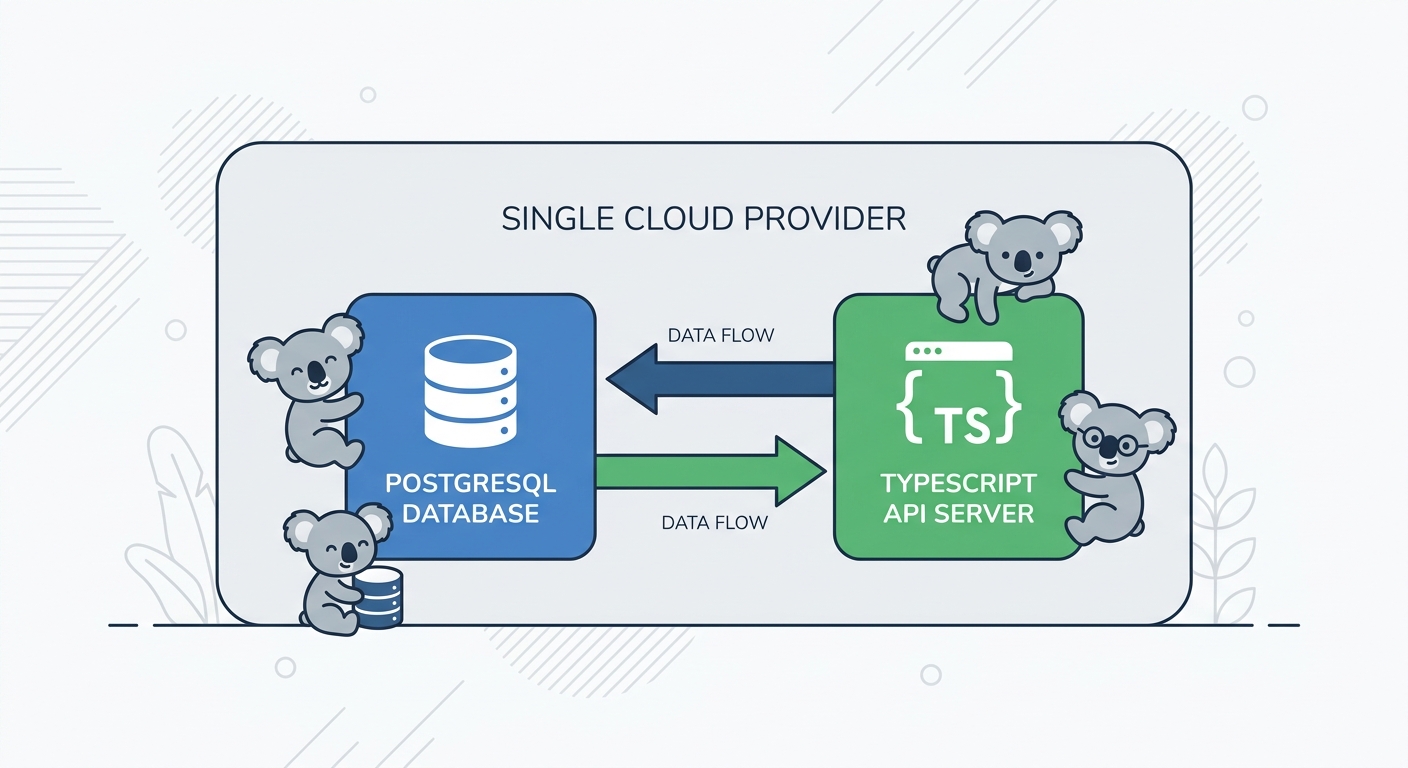
Data layer: PostgreSQL. Not MySQL, not SQLite-in-production, not a managed NoSQL service. PostgreSQL handles JSON, full-text search, geospatial queries, and scales further than you think. When you eventually need to shard or move to something specialized, you’ll have the revenue to pay for that problem.
Application runtime: A statically-typed language with good tooling. TypeScript/Node for API servers, Go for anything performance-sensitive. Both have boring deployment stories and deep hiring pools.
Infrastructure: Managed services from a major cloud provider. Not multi-cloud. Not hybrid. Pick AWS, GCP, or Azure based on your team’s existing expertise and stay there until you’re spending enough to negotiate contracts.
Deployment: Containers on a managed platform—ECS, Cloud Run, or managed Kubernetes if you have the expertise. Not bare metal. Not serverless functions for core business logic. Not edge compute unless latency is genuinely your differentiator.
Frontend: React. Yes, there are newer frameworks. No, the hiring pool and ecosystem depth don’t compare yet. Use Next.js if you need SSR, plain Vite if you don’t.
This stack is unglamorous. It will not generate conference talks. It will ship features.
When to Spend an Innovation Token
Boring technology is a default, not a religion. Spend your tokens when:
The boring option genuinely cannot solve your problem. If you’re building real-time collaborative editing, you might need CRDTs. If you’re processing petabyte-scale event streams, you might need something beyond PostgreSQL. The key word is “might”—validate the limitation is real before reaching for complexity.
The exciting option has become boring for your specific use case. Some teams have years of production experience with technologies that are new to the broader market. That’s their boring, even if it’s not yours.
The technology directly enables your product differentiation. If machine learning is your product, the ML stack is where you spend tokens. If you’re building a developer tool, your CLI experience might justify exotic choices. But the technology must be the product, not adjacent to it.
The Real Cost of Interesting
The cost of interesting technology isn’t primarily in the initial build. It’s in the ongoing maintenance, the debugging sessions without Stack Overflow answers, the candidates who pass on your company because they don’t want to learn your stack.
For early-stage technical founders, the goal is survival. Boring technology keeps you alive long enough to discover what truly requires innovation.
At Koalabs, we help technical teams make these infrastructure decisions and ship products without the cost of full-time hires. If you’re a founder evaluating your technology stack—or questioning choices you’ve already made—we should talk.