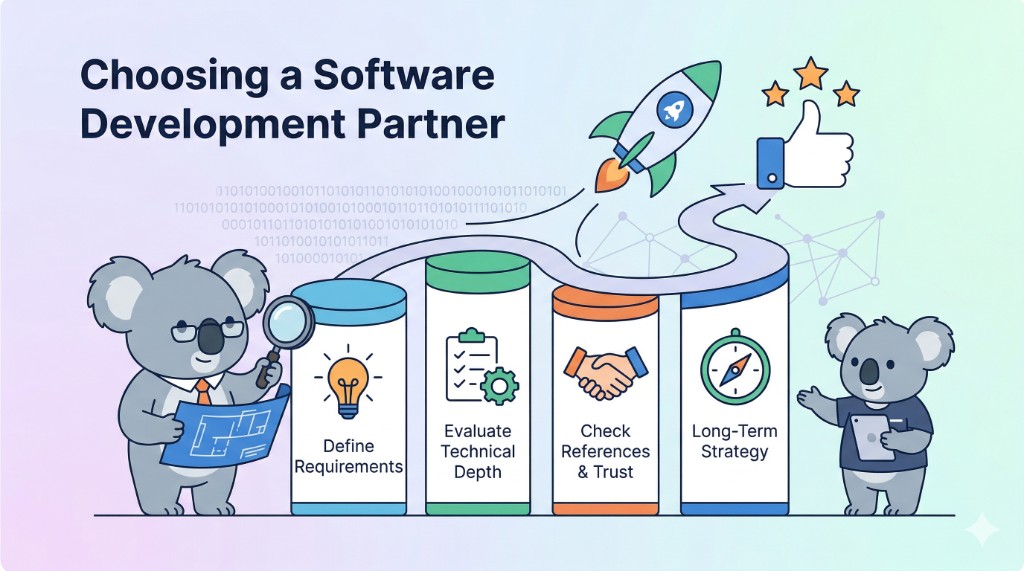
Choosing a software development partner is not just a vendor decision — it is a strategic business commitment. The right partner accelerates your product roadmap, reduces risk, and brings technical expertise you may not have in-house. The wrong one can cost you months of delays, rework, and budget overruns.
This guide walks you through exactly what to look for so you can make a confident, informed choice.
Why the Right Partner Matters More Than You Think
Many businesses underestimate the complexity of building software. They focus on price and overlook factors that have a far greater impact on outcomes: communication style, technical depth, domain experience, and cultural fit.
According to the Standish Group’s CHAOS Report, over 66% of software projects experience cost overruns or schedule delays — most of which trace back to poor requirements, misaligned expectations, or weak technical execution. The partnership you choose determines which side of that statistic you land on.
1. Define Your Requirements Before You Start Talking to Anyone
Before evaluating any firm, get internal alignment on:
- What problem are you solving? Can you articulate it in two sentences?
- What does success look like in 6 months? 12 months?
- What are your non-negotiables? (Technology stack, compliance requirements, integrations)
- What is your realistic budget range?
- Do you need ongoing maintenance after launch, or just a build?
Without clear answers to these questions, you cannot evaluate proposals objectively. Vendors will fill the gaps with their assumptions — not yours.
2. Evaluate Technical Depth, Not Just a Portfolio
A polished case study deck is easy to produce. Technical competence is harder to fake under scrutiny. When reviewing a potential partner, go beyond the surface:
Ask for architecture walkthroughs
Request that their technical lead walk you through a past project’s architecture — how they handled scalability, database design, third-party integrations, and security. A strong team will be eager to talk through this. A weak one will dodge specifics.
Review their code samples or open-source contributions
Real code reveals far more than slide decks. Look for clean abstractions, meaningful test coverage, and consistent code style.
Assess their technology stack alignment
Ensure they have proven experience with the technologies your project requires. Beware of firms that claim expertise in every language and framework — deep specialization matters.
3. Prioritize Communication Over Everything
The number one predictor of a successful engagement is not technical skill alone — it is communication. A highly skilled team that communicates poorly will produce results that miss the mark. Ask yourself:
- How quickly do they respond to emails or messages?
- Are their project managers clear and proactive, or do they wait to be chased?
- Do they ask the right clarifying questions, or do they just say yes to everything?
- Do they push back constructively when they disagree, or do they simply execute without judgment?
A partner who asks hard questions before starting work is a partner who cares about delivering the right outcome.
4. Check References — and Ask the Right Questions
Speaking to a firm’s past clients is invaluable, but only if you ask the right questions:
- Did they deliver on time and on budget? If not, what happened?
- How did they handle problems or unexpected complexity?
- Would you hire them again? (Follow-up: “Why or why not?”)
- What would you do differently in working with them?
- How was the handoff documentation and post-launch support?
Two or three candid reference calls will reveal more than ten hours of demos and sales decks.
5. Red Flags to Watch Out For
Avoid partners who:
- Quote without scoping — Any serious firm requires discovery work before providing a meaningful estimate.
- Promise unrealistic timelines — If it sounds too fast to be true, it probably is.
- Can’t explain their development process — Agile, Scrum, Kanban — they should be able to articulate how work flows through their team.
- Have no dedicated QA process — Manual or automated, testing should be a first-class concern.
- Resist contract milestones — A reputable firm welcomes clear payment tied to deliverables.
- Have no post-launch support plan — Software is a living product; who maintains it after go-live?
6. Understand the Engagement Model
Different projects call for different engagement structures:
| Model | Best For |
|---|---|
| Fixed Price | Well-defined scope with minimal unknowns |
| Time & Materials | Exploratory or evolving projects |
| Dedicated Team | Ongoing product development needing full integration |
| Staff Augmentation | Filling specific skill gaps in your existing team |
Be wary of any firm that only offers one model regardless of your project type. Flexibility signals experience.
7. Think Long-Term, Not Just Launch Day
The best partnerships last beyond a single engagement. When evaluating a firm, consider:
- Knowledge transfer — Will they document the codebase thoroughly so your internal team (or future vendors) can maintain it?
- Scalability — Can they grow with your needs as your business scales?
- Cultural alignment — Do they operate with transparency and accountability, or do they disappear between milestones?
What to Expect When Working with Koalabs
At Koalabs, we believe great software starts with honest conversations. Before we write a single line of code, we invest time understanding your business goals, technical constraints, and what success truly looks like for your team.
We offer structured discovery engagements, transparent project planning, and ongoing communication so you are never left wondering what is happening with your investment.
If you are evaluating software development partners and want a candid conversation about your project, reach out to our team. No sales pitch — just a direct discussion about what you need and whether we are the right fit.
Koalabs is a US-based software consultancy specializing in custom software development, cloud architecture, and technical consulting for businesses across all industries.